
What Causes Time-Varying Propagation Delay In Satellite Links?
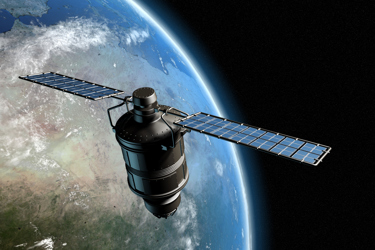
Propagation delay is a fundamental characteristic of every satellite communication link, representing the time required for a signal to travel between a transmitter and receiver. While the concept is straightforward, accurately modeling propagation delay becomes increasingly important as non-terrestrial networks (NTNs) rely on satellites in low- and medium-Earth orbits, where distances change continuously throughout a pass.
Unlike fixed terrestrial links or geostationary (GEO) satellite systems, where signal paths remain relatively constant, LEO and MEO satellites are constantly moving with respect to ground stations. As the satellite approaches, passes overhead, and moves away, the separation distance changes, causing propagation delay to vary over time. This dynamic behavior affects signal timing and must be accurately represented during system testing to ensure reliable communications under real operating conditions.
This article explains the physics behind time-varying propagation delay and illustrates how it evolves during a satellite pass through an interactive visualization. By seeing how delay changes as orbital geometry shifts, engineers gain a clearer understanding of one of the key impairments affecting NTN performance.
The article also explores why realistic propagation delay emulation requires more than simply adding or removing signal samples. Maintaining phase continuity and preserving the natural relationship between delay and Doppler demands sophisticated resampling techniques that accurately reproduce satellite motion. Advanced channel emulation allows engineers to recreate these changing conditions in the laboratory, enabling more realistic receiver testing, earlier identification of performance issues, and greater confidence that communication systems will operate reliably once deployed in orbit or on the ground.
Get unlimited access to:




Enter your credentials below to log in. Not yet a member of RF Globalnet? Subscribe today.