
Report: U.S. Wireless Handset Revenue On The Rise
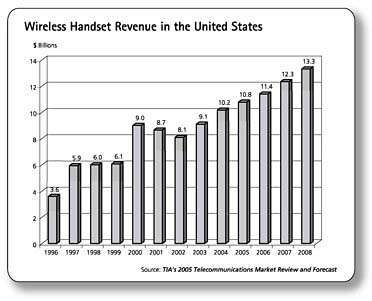
Arlington, VA -- Wireless handset spending in the United States will rise to $13.3 billion in 2008 from 10.1 billion in 2004, growing at a 7.0% compound annual rate (CAGR), according to the Telecommunications Industry Association (TIA). This growth is attributable to increased functionality as well as increases in subscribers. As overall subscriber growth slows and new users provide less of a boost than in the past, the replacement market will become the primary focus to increase subscribers.
"Going forward, the slowdown in U.S. subscriber growth will cut into the handset market, but high levels of replacement sales, spurred by the introduction of new features such as cameras, video recorders, games, etc., will continue to fuel growth," Matthew J. Flanigan, TIA president, said.
"Recent business announcements, such as Major League Baseball partnering with MobiTV reveal that entertainment companies are among those taking advantage of innovative wireless applications," he added.
Camera phones are one of the most popular features and are estimated to comprise 60% of shipments by 2006. Smart phones, which combine a phone with other applications such as an organizer, are an emerging segment of the market. Smart phones comprised about 2% of the market in 2003 and are expected to increase as much as 25% by 2010.
Overall handset unit sales in the United States rose 10.2% in 2004 to 74.2 million. With prices increasing slightly to an average of $137 and increases in the replacement market, spending on handset units rose 11.9%, to $10.2 billion in 2004. (Prices for handsets turned around in 2004 and will continue to edge up to $156 in 2008 as new features increase costs.) Handset sales are projected to rise to 85.3 million by 2008, representing a 3.5% CAGR.
TIA's 2005 Telecommunications Market Review and Forecast provides a current overview of telecom's market segments including landline network, enterprise and consumer, wireless communications, and international markets.
Source: Telecommunications Industry Association (TIA)