
New Software Module Enables EM Wave Simulation For RF/Microwave/Photonic Design
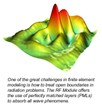
 Burlington, MA -- The newly-developed RF Module for COMSOL Multiphysics enables simulation capabilities for the design of RF, microwave, and photonics components, and in general the software allows the study of components and systems that deal with propagating electromagnetic waves. With it users can design and prototype devices for the transmission, guiding, receiving, and filtering/processing of electromagnetic waves in applications where the range of frequencies spans from radio to optical.
 With the module, users can consider all sorts of multiphysics effects, including the interconnection of electromagnetics phenomena with heat transfer, structural mechanics, and more. For instance, it is possible to see what effects heating has upon the frequency response of a microwave filter. Users can also see in high-power microwave waveguides or switches how close a design gets to safety margins before electric breakdown of air or a gas occurs. They can then experiment with software on a better physical design or choice of materials to increase safety margins. The module provides a ready-made multiphysics coupling for microwave heating.
A feature of the RF Module is the characterization of S-parameters/reflection-transmission coefficients. For a given geometry and set of physics, users can determine such values over a wide range of frequencies. This S-parameter analysis is suitable for waveguides, antennas, filters, directional couplers, switches, microwave amplifiers, transmission lines, and impedance-matching networks.
Designing Stealth Technology and T-rays Applications
The module also serves to help scientists learn more about a new field called metamaterials, also known as left-handed or negative-index materials, in which the permeability and permittivity are simultaneously negative. These materials create all sorts of unusual phenomena: They break the diffraction limit to improve resolution in optical devices such as microscopes, they reverse the Doppler effect, and they can create very low reflectance, which is useful in stealth technology. With the RF Module scientists can analyze the frequency-dependent properties of such materials and learn how to build optical or microwave components using them.
An emerging technology in electromagnetic-wave engineering is the transmission of terahertz rays. These so-called T-rays are suited for applications such as the detection of explosives or contraband, defect analysis, moisture monitoring, medical diagnostics, trace-gas detection, and biomedical imaging. Comments Dr. Jason Deibel of the Mittleman Terahertz Research Group at Rice University, "COMSOL Multiphysics can be effectively and efficiently used to model engineering problems and phenomena associated with terahertz wave propagation." Specifically, he successfully used this software to evaluate the design of a radial photoconductive terahertz antenna (for details, see www.comsol.com/stories/terahertz).
To help users learn how to apply the RF Module, the software comes with a Model Library with more than 25 examples. One typical example optimizes the design of a microwave filter by accounting for material and geometric shape changes induced by thermal strains; another examines the operation of a microwave oven with heat dissipation in food. Each model has a detailed technical description of the underlying physics along with step-by-step instructions on how to create the model.
The RF Module starts shipping September 1, 2006.
SOURCE: COMSOL, Inc.