
Additive Manufacturing: Revolutionizing The Aerospace Workflow

By John Oncea, Chief Editor, Clinical Tech Leader
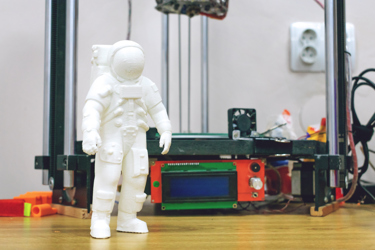
Additive manufacturing just might be the answer to alleviating the supplier shortage surrounding electronic components used in the harsh environment of space.
Designing and manufacturing electronic components for use in the harsh environment of space is a complex task. Radiation levels in space vary depending on a spacecraft’s orbit and the thermal cycles that occur when a spacecraft moves in and out of direct sunlight can cause temperatures to plummet to as low as -276F or soar to as high as 226F in geosynchronous orbit.
Developing a new design or manufacturing process that can produce reliable electronic components for use in these extreme conditions is a daunting task requiring a high level of precision and attention to detail. That said, these components must function seamlessly in the challenging environment of space to ensure that missions are successful and safe.
Due to the relatively low demand for space-qualified electrical components and the irregular procurement schedules of the aerospace industry, it is not financially feasible for manufacturing companies to maintain a dedicated production line solely for space components. As a result, space programs are often forced to rely on only a handful of suppliers or even a single source of these components.
This concentration of suppliers creates an undesirable scenario, as it greatly increases the risk of supply chain disruptions that could potentially halt entire space missions. To ensure reliable and successful space missions in the future, action must be taken to diversify the supply chain of space-qualified electronic components. This can be achieved through incentivizing new manufacturers to enter the space components market, investing in research and development of new and improved space-qualified technologies, and encouraging greater collaboration between industry, academia, and government agencies to foster innovation and growth in the sector.
That said, groups such as The Small Business Innovation Research (SBIR) program – which encourages domestic small businesses to engage in Federal Research/Research and Development with the potential for commercialization – suggest that, although desirable, a single process for multiple types of components is unlikely.
So, What Are Some Solutions
Mobility Engineering Tech suggests one alternative: additive manufacturing (AM). “With greater design and manufacturing flexibility, AM offers compelling opportunities to revolutionize critical elements of the aerospace workflow.”
The use of AM for Radio Frequency (RF) passive hardware in telecommunications satellites is a potential game changer. These parts can receive, carry, filter, and transmit RF signals from Earth to a satellite and back, enabling communication even with very weak signals. To achieve the most efficient transmission technology, satellites must be equipped with directional antennae, filters, and waveguides that are highly complex in design, exact in dimensional control, weight, volume, and surface quality.
Traditional manufacturing processes necessitate multiple complex and specialized processes such as machining, extrusion, welding, and manual assembly, leading to long lead times and high costs. However, the application of AM techniques has enabled engineers involved in RF engineering to significantly reduce the limitations posed by conventional processes. They have greater flexibility to tailor their RF components for performance and system-wide efficiency, resulting in profound benefits such as improved RF performance, lower weight, and volume, as well as the large reduction of parts through unitization.
An antenna's primary function is to receive and transmit signals from and to Earth. The waveguides function as low-loss systems to transfer RF signals inside the satellite. The filters minimize the noise from unwanted frequencies so that only the necessary signals pass through. The structures feature intricate and precise designs which can only be achieved with AM techniques.
The use of AM techniques is particularly advantageous in the production of satellite RF components since it not only increases the speed of production but also negates the need for specialized labor. The pre-existing lead times are significantly reduced, further reducing production costs. Engineers can now improve RF component performance, reducing weight and space constraints while eliminating the need for complex multiple parts, leading to cutting-edge technological advancements.