
Laminates
PRODUCTS AND SERVICES
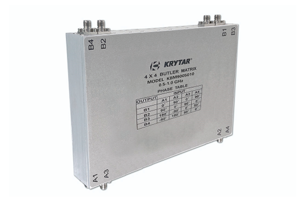
The new KRYTAR 4×4 Butler Matrix uses KRYTAR’s high-performance 90- and 180-degree Hybrid Couplers providing super phase accuracy, amplitude imbalance, stability and repeatability.

Qorvo offers the 1800 W, 65 V, 1.0 – 1.1 GHz QPD1025L as the highest GaN transistor on the market. This discrete GaN on SiC HEMT has a package that features input pre-match resulting in ease of external board match and saved board space.

The SKY53746-11 is a diversity receive module and is scalable to support two CA MIMO regional and roaming band requirements. The SKY53746-11 is part of our Sky5 product portfolio.

JFW’s 50PA-1183-XX and 50BA-048-95 are two attenuator assembly models designed to help automate Wi-Fi 6E testing. Both models use 0-95dB x 1dB step attenuators that operate 0.2-8 GHz, and feature Ethernet and serial remote control with a command set that is script friendly.
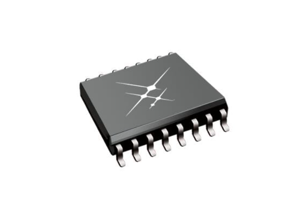
The Si858x products combine robust fully compliant RS-485 transceivers with Skyworks' Proprietary CMOS isolation technology.
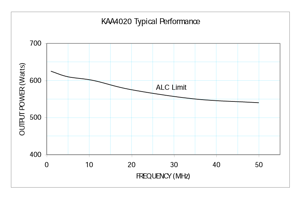
The KAA402* Series of 19" Rack Mount RF Amplifiers consists of three models, KAA4020, KAA4020P, and KAA4021P. These Class AB wideband RF power amplifiers deliver more than 500 Watts CW power into a 50-Ohm load over the frequency range of 1MHz to 50MHz.
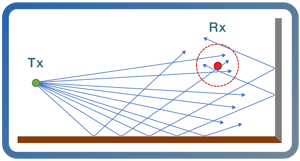
Ray-tracing methods use discrete rays to represent advancing wavefronts as they propagate from a transmitter through a scene. Rays interact with geometry in the scene through reflections, diffractions, and transmissions. The two dominant ray-tracing methods are Shooting-and-Bouncing Rays and Image Theory. Remcom’s software combines these two methods to leverage the advantages of each.