
Wi-Fi, WiMAX To Drive Wireless Equipment Spending To $29.3 Billion By 2008
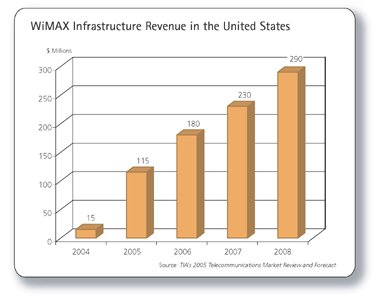
Arlington, VA -- Wi-Fi and WiMAX infrastructure revenues are expected to reach $5.2 billion and $115 million, respectively, in 2005, according to TIA's 2005 "Telecommunications Market Review and Forecast," an annual publication of the Telecommunications Industry Association (TIA). The Wi-Fi equipment market is increasing at a fast pace and will continue to grow as hot spots proliferate. An emerging WiMAX equipment market will also contribute to growth in the coming years. TIA expects revenue from spending on wireless capital expenditures/Wi-Fi/WiMAX to reach an estimated $22.3 billion in 2005, climbing to $29.3 billion by 2008, a 7.1% compound annual gain.
Spending on services in support of the wireless infrastructure (including Wi-Fi and WiMAX), such as basic services and support (e.g., field maintenance and repair), professional services, and depot repair and logistics rose 13.6% in 2004, rebounding from the 31.8% drop in 2003 associated with the drop in wireless infrastructure spending.
"With the Wi-Fi and WiMAX markets expanding rapidly, we will begin to see more demand for mobile broadband and broadband connectivity. Major carriers such as SBC, Verizon, and Sprint have already announced deals to expand the number of hot spots and to broaden their networks," stated TIA president Matthew J. Flanigan. "It is likely that both of these markets will stimulate the overall broadband market to the benefit of all technologies."
Wi-Fi, which includes wireless standards 802.11, 802.11a, 802.11b, and 802.11g, represents a small but quickly growing component of wireless communications services. Spending on Wi-Fi services reached $21 million in 2004 and is expected to increase to $45 million in 2005 and continue to climb at a 99.9% compound annual growth rate (CAGR) to $335 million by 2008. Although experiencing healthy growth on a percentage basis, aggregate revenue is expected to remain relatively low, because most Wi-Fi services are either offered free as a promotion or bundled with other services. Consequently, according to the report, Wi-Fi is not expected to become a significant source of service revenue by itself. Rather, it is expected to stimulate other revenue by attracting business and by growing the equipment market. Spending on Wi-Fi equipment rose 31.8% in 2004 to $4.35 billion. The proliferation of Wi-Fi access points (hot spots), the expansion of wireless corporate local area networks (LANs), and growth in the use of network interface cards (NICs) as standard equipment in laptops will boost spending. Spending on Wi-Fi infrastructure equipment is expected to total $7 billion in 2008, a 12.6 compound annual increase.
The number of Wi-Fi hot spots in the United States increased more than six-fold from 2002 to 2004, from 3,400 to 21,500. The number of hot spots in the United States is expected to increase from 32,800 in 2005 to 64,200 in 2008, growing at a 31.5 CAGR.
WiMAX is emerging as a last-mile broadband wireless Internet access solution. WiMAX provides wireless services in the metropolitan area network (MAN) just as Wi-Fi provides wireless services in LANs. WiMAX has the potential to make broadband service available in regions where it is currently not feasible, particularly in rural communities. When certified products become available, the market will expand. Costs should be less than for Wi-Fi because WiMAX is a standards-based technology. Spending on WiMAX infrastructure is expected to increase dramatically in the next few years, growing from $15 million in 2004 to $115 million in 2005, a 666.7% increase, and then rising to $290 million by 2008, growing at a 109.7% CAGR. Infrastructure revenue includes CPE, point-to-point equipment used in backhauling LANs to the Internet and point-to-multipoint equipment used in broadband access. WiMAX is potentially disruptive, in that it could compete with other high-speed fixed solutions, including DSL and cable modems, as well high-speed mobile solutions like 3G.
Source: Telecommunications Industry Association (TIA)