
5G Breakthrough? Samsung Develops mmWave Adaptive Array Transceiver
By Jim Pomager, Executive Editor
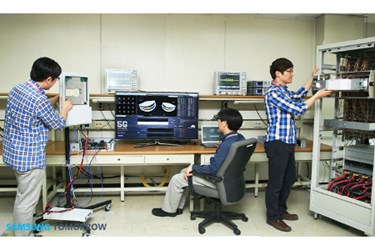
Even though true 4G cellular is yet to arrive, Samsung claims to have already taken a major step toward 5G with the development of a new millimeter-wave adaptive array transceiver. The device, which operates in the Ka band (28 GHz), achieves data transmission speeds of up to 1.056 Gbit/s over distances of up to 2 km. Samsung believes this technology will ultimately provide the foundation for 5G mobile communications systems and enable data transmission speeds hundreds of times faster than current networks.
The millimeter-wave region is a compelling option for mobile broadband, with its great expanses of available spectrum situated far from the congestion and squabbling of the lower frequencies. But there are really good technical reasons why nobody’s currently using it — millimeter waves suffer high propagation losses over long distances and significant signal attenuation in the atmosphere (due to fog, rain, snow, etc.). Samsung claims to have overcome these issues by, among other things, integrating 64 antenna elements into its new adaptive array transceiver design.
The early performance data (what little of it Samsung is offering at this point) is definitely impressive. For comparison’s sake, a recent Root Metrics report showed that the fastest of the current generation of “4G” services — which technically are not 4G but are still marketed as such by wireless carriers — offers download speeds of <20 Mbit/s under real world conditions. True 4G technology, as defined by the International Telecommunication Union’s IMT Advanced requirements, could hit the market later this year and bring with it peak download speeds of up to 1 Gbit/s. Samsung has already exceeded 1 Gbit/s… and its 5G technology development is still in the embryonic stage.
Speaking of which, Samsung says it plans to seriously accelerate its 5G R&D, including further development of its adaptive array transceiver technology, in hopes of commercializing 5G by 2020. The company brashly declared that its new transceiver technology will “invigorate research into 5G cellular communications across the world,” and “trigger the creation of international alliances and timely commercialization of related mobile broadband services.”
Bold claims, especially given the dearth of details regarding this new transceiver design. Plus, the competition is shaping up to be intense, with China's Ministry of Industry and Information Technology pouring resources into 5G research and the European Commission earmarking €50 million for 5G development. Still, there’s no arguing that Samsung’s new technology offers an interesting possible solution to the “spectrum crisis” and a tantalizing glimpse at future mobile broadband network capabilities.
What are your thoughts about this development? Is anyone working on or aware of similar technologies? Of other approaches to 5G? Please share your thoughts below.
Image courtesy of Samsung Tomorrow