
R&S Offers First Test Scenarios For Downlink Advanced Receiver Performance (DARP)
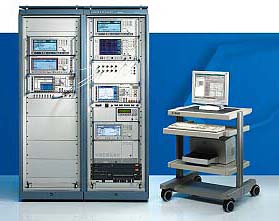 Columbia, MD -- Rohde & Schwarz clams it is the first company to offer five test scenarios for downlink advanced receiver performance (DARP), a method that increases network capacity by reducing interference in mobile radio networks. The test scenarios can be run on the company's TS895xG family of RF test systems. Rohde & Schwarz is one of the companies involved in compiling the test specification for DARP, which is expected to be completed in April 2005.
Interference occurs in every mobile radio network as transmitted signals are superimposed on each other in individual radio cells. DARP can detect these unwanted signals in the cell and suppress them. At the chip level, two optional algorithms can be implemented in GSM mobile radio phones to detect interference. DARP substantially increases network capacity and has sparked the interest of both wireless service providers and mobile phone manufacturers.
Under real network operating conditions, several different signals from adjacent radio cells may be superimposed on the wanted signal. The interfering base stations transmit their signals simultaneously or with a delay of a few bits. The test scenarios simulate up to four unwanted signals that are transmitted synchronously or asynchronously to the wanted signal. The unwanted signals can use the same frequency as the wanted signal or an adjacent frequency. It is also possible to vary the codes of the training sequences included in the transmitted data packets of the unwanted signals.
Rohde & Schwarz already offers the first five DARP test cases for its TS895xG family of RF test systems. The test cases cover the most important test requirements and support mobile radio manufacturers in the development of DARP-compatible mobile radio phones. All test cases specified by the TS 51.010 DARP standard are expected to be available in mid 2005 for the TS895xG family.
Source: Rohde & Schwarz